

CLINICAL RESEARCH · THE SHINE TRIAL

The SHINE Trial.

12 weeks of SiPore21, powered by SiPore®, compared with placebo in 318 adults.

In adults with overweight or obesity and prediabetes or newly diagnosed type 2 diabetes, SiPore21 reduced body weight, fat mass and LDL-cholesterol compared with placebo, and HOMA-B (a marker of beta-cell function) held steady while it declined with placebo. HbA1c fell significantly from baseline with SiPore21; the difference from placebo was not statistically significant. SiPore21 was generally well tolerated. Published in eClinicalMedicine (The Lancet Discovery Science), 2026.

Clinical research setting
STUDY DESIGN

Randomized · double-blind · placebo-controlled · multicentre.

SHINE (SiPore Halts Intermediate Hyperglycaemia) ran from October 2023 to July 2024 and is registered at ClinicalTrials.gov as NCT06087822.

318
participants randomized 1:1
12 weeks
of SiPore21 or placebo
27
centres in Poland, Romania and Slovakia
9 g
a day: 3 g with each main meal

312 participants completed the 12-week intervention. Source: Baek J, et al. eClinicalMedicine 2026;97:104042 (Methods).

WHO TOOK PART AND WHAT WAS MEASURED

The study at a glance.

POPULATIONAdults aged 18–70 with overweight or obesityBMI over 25 and up to 40 kg/m², and HbA1c of 42–58 mmol/mol (6–7.5%): prediabetes or newly diagnosed type 2 diabetes. Participants kept their usual diet and physical activity.
INTERVENTIONSiPore21 oral gelEngineered mesoporous silica particles, 3 g three times a day with breakfast, lunch and dinner (9 g a day), for 12 weeks.
COMPARATORMatching placeboIdentical in appearance, taste, texture, smell and packaging. Participants, investigators, site staff and statisticians were blinded.
PRIMARY OUTCOMEChange in HbA1c from baseline to week 12The main secondary endpoint was change in body weight; others included lipids, body composition and other metabolic markers. Safety and tolerability were assessed throughout.
ANALYSISPre-specified and post hocThe primary analysis used all participants with at least one dose and one post-baseline HbA1c value. The paper reports its efficacy results from post hoc analyses of the per-protocol set (134 SiPore21, 127 placebo).
KEY RESULTS · BODY COMPOSITION

Body weight and fat mass fell more with SiPore21 than with placebo.

Mean change from baseline to week 12. Lean (fat-free) mass did not change in either group.

kg

Body weight and fat mass fell more with SiPore21 than with placebo.Grouped columns chart. 2 series. SiPore21 ranges from −1.21 kg (Fat mass) to 0.16 kg (Fat-free mass). Placebo ranges from −0.49 kg (Body weight) to 0.14 kg (Fat-free mass).−1.5−1.0−0.50.00.5−1.14−0.49−1.21−0.480.160.14Body weightFat massFat-free mass
Body weight and fat mass fell more with SiPore21 than with placebo.Grouped columns chart. 2 series. SiPore21 ranges from −1.21 kg (Fat mass) to 0.16 kg (Fat-free mass). Placebo ranges from −0.49 kg (Body weight) to 0.14 kg (Fat-free mass).−1.5−1.0−0.50.00.50.160.14Body weightFat massFat-free mass

Between-group p-values: body weight p = 0.0374, fat mass p = 0.0500, fat-free mass p = 0.9959.

Source Baek J, et al. eClinicalMedicine 2026;97:104042, Table 2

Body weight and fat mass fell more with SiPore21 than with placebo.
MeasureSiPore21Placebo
Body weight−1.14 kg−0.49 kg
Fat mass−1.21 kg−0.48 kg
Fat-free mass0.16 kg0.14 kg

KEY RESULTS · LIPIDS

LDL-cholesterol and total cholesterol fell compared with placebo.

Mean change from baseline to week 12.

mg/dL

LDL-cholesterol and total cholesterol fell compared with placebo.Grouped columns chart. 2 series. SiPore21 ranges from −6.17 mg/dL (LDL-C) to −4.84 mg/dL (Total cholesterol). Placebo ranges from −1.02 mg/dL (LDL-C) to 0.82 mg/dL (Total cholesterol).−8−6−4−202−6.17−1.02−4.840.82LDL-CTotal cholesterol
LDL-cholesterol and total cholesterol fell compared with placebo.Grouped columns chart. 2 series. SiPore21 ranges from −6.17 mg/dL (LDL-C) to −4.84 mg/dL (Total cholesterol). Placebo ranges from −1.02 mg/dL (LDL-C) to 0.82 mg/dL (Total cholesterol).−8−6−4−2020.82LDL-CTotal cholesterol

Between-group p-values: LDL-C p = 0.0350, total cholesterol p = 0.0496. In participants not taking a statin, LDL-C fell by 8.9 mg/dL and total cholesterol by 7.4 mg/dL from baseline with SiPore21.

Source Baek J, et al. eClinicalMedicine 2026;97:104042, Table 2 and Results

LDL-cholesterol and total cholesterol fell compared with placebo.
MeasureSiPore21Placebo
LDL-C−6.17 mg/dL−1.02 mg/dL
Total cholesterol−4.84 mg/dL0.82 mg/dL

KEY RESULTS · GLYCAEMIC CONTROL

HbA1c fell from baseline; beta-cell function held steady.

HbA1c fell significantly from baseline with SiPore21 (p = 0.0036) but not with placebo (p = 0.0872). The difference between the groups was not statistically significant (p = 0.5134); the authors point to a pronounced placebo response in men. In a post hoc analysis of women, the HbA1c reduction compared with placebo was statistically significant (p = 0.019).

−0.91
mmol/mol HbA1c change with SiPore21
−0.60
mmol/mol HbA1c change with placebo
−0.75
HOMA-B change with SiPore21
−16.52
HOMA-B change with placebo (p = 0.0050)

Source: Baek J, et al. eClinicalMedicine 2026;97:104042, Summary and Table 2. HOMA-B is the homeostatic model assessment of beta-cell function.

KEY RESULTS · GLYCAEMIC STATUS (POST HOC)

Fewer moved into the diabetes range; more moved back to prediabetes.

Share of participants whose glycaemic category changed over 12 weeks.

Fewer moved into the diabetes range; more moved back to prediabetes.Grouped columns chart. 2 series. SiPore21 ranges from 6.06% (Prediabetes → type 2 diabetes) to 23.81% (Type 2 diabetes → prediabetes). Placebo ranges from 10.29% (Prediabetes → type 2 diabetes) to 11.76% (Type 2 diabetes → prediabetes).0%5%10%15%20%25%6.06%Prediabetes → type 2 diabetesType 2 diabetes → prediabetes
Fewer moved into the diabetes range; more moved back to prediabetes.Grouped columns chart. 2 series. SiPore21 ranges from 6.06% (Prediabetes → type 2 diabetes) to 23.81% (Type 2 diabetes → prediabetes). Placebo ranges from 10.29% (Prediabetes → type 2 diabetes) to 11.76% (Type 2 diabetes → prediabetes).0%10%20%30%Prediabetes →type 2 diabetesType 2 diabetes→ prediabetes

Progression was a statistically significant change within the placebo group (p = 0.0233); reversion was a statistically significant change within the SiPore21 group (p = 0.0044). Categories by HbA1c at baseline: prediabetes below 48 mmol/mol (6.5%), type 2 diabetes 48 mmol/mol or above.

Source Baek J, et al. eClinicalMedicine 2026;97:104042, Table 2

Fewer moved into the diabetes range; more moved back to prediabetes.
Change in categorySiPore21Placebo
Prediabetes → type 2 diabetes6.06%10.29%
Type 2 diabetes → prediabetes23.81%11.76%

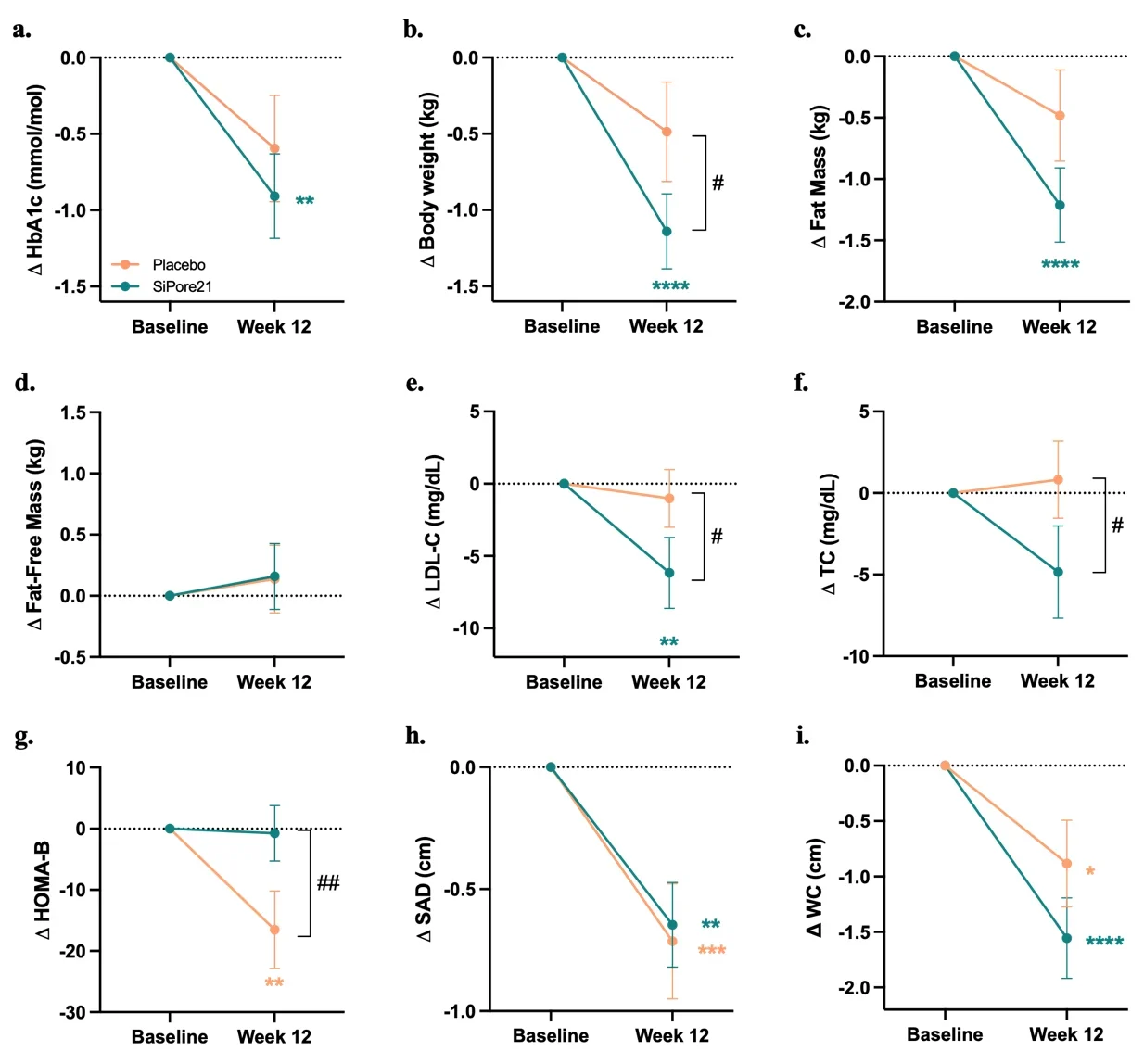
FROM THE PAPER · FIG. 2

Change from baseline to week 12, SiPore21 and placebo.

(a) HbA1c, (b) body weight, (c) fat mass, (d) fat-free mass, (e) LDL-C, (f) total cholesterol, (g) HOMA-B, (h) sagittal abdominal diameter and (i) waist circumference. Mean ± SEM. Figure: Baek J, et al., eClinicalMedicine 2026, licensed under CC BY 4.0.

Fig. 2 of the SHINE paper: nine line charts of change from baseline to week 12 for SiPore21 and placebo
SAFETY AND TOLERABILITY

Generally well tolerated, with high adherence.

Adverse events were mainly mild and transient gastrointestinal symptoms such as diarrhoea, nausea, constipation and flatulence. Five participants in each group withdrew because of adverse events.

96.4%
adherence with SiPore21 (97.1% placebo)
13.2%
adverse device effects with SiPore21 (8.2% placebo; not significantly different)
14.5%
gastrointestinal adverse events with SiPore21 (8.2% placebo)
0
serious adverse device effects in either group

Source: Baek J, et al. eClinicalMedicine 2026;97:104042, Safety outcomes and Table 3.

CLINICAL EVIDENCEWHAT IT MEANS

What SHINE adds to the evidence.

SHINE is the largest SiPore® clinical study to date. In its population, SiPore21 was associated with changes across several metabolic markers at once — body weight, fat mass, LDL-cholesterol, total cholesterol and beta-cell function — compared with placebo. SiPore® works locally in the gut: its engineered pores entrap a portion of the digestive enzymes that break down carbohydrates and fats, so digestion happens more gradually. The authors describe SiPore21 as a possible non-pharmacological approach alongside lifestyle change, and call for longer studies in broader populations.

These are outcomes measured over 12 weeks — not first-meal effects. Results relate to SiPore21 at 9 g a day in the population studied. Technology-level evidence belongs to SiPore. Finished-product claims must be supported for the specific product, dose, format and regulatory category.

LIMITATIONS

What the study cannot tell us.

As stated in the paper, these limits matter when reading the results.

DURATION12 weeksToo short to judge long-term efficacy and safety, how long the benefits last, or long-term effects on nutrient absorption.
ANALYSISExploratory secondary resultsThe study was powered for the primary endpoint only. Secondary and post hoc analyses were not individually powered and are exploratory.
PRIMARY ENDPOINTNo significant HbA1c difference vs placeboA pronounced placebo response, especially in men, may have increased variability and attenuated the treatment effect.
EFFECT SIZESmaller than with medicinesChanges were smaller than with established pharmacological therapies; their clinical relevance should be interpreted with caution.
POPULATIONOne population, three countriesAdults aged 18–70 with overweight or obesity in Poland, Romania and Slovakia; almost all participants were White.
FUNDINGSponsored by Sigrid Therapeutics ABThe sponsor supplied SiPore21 and placebo and was involved in design, data collection and analysis, interpretation and writing.
FAQ

Questions about SHINE

What was the SHINE trial?

A 12-week, randomized, double-blind, placebo-controlled, multicentre clinical trial of SiPore21, a product based on SiPore® technology. It was run at 27 centres in Poland, Romania and Slovakia and published in eClinicalMedicine (The Lancet Discovery Science) in 2026.

Who took part?

318 adults aged 18–70 with overweight or obesity (BMI over 25 and up to 40 kg/m²) and HbA1c of 42–58 mmol/mol (6–7.5%), meaning prediabetes or newly diagnosed type 2 diabetes. 312 completed the 12 weeks.

What did participants take?

SiPore21, an oral gel containing engineered mesoporous silica particles, or a matching placebo: 3 g with each main meal, three times a day (9 g a day), for 12 weeks.

Did SiPore21 lower HbA1c?

HbA1c fell significantly from baseline with SiPore21 (on average −0.91 mmol/mol, p = 0.0036) and not with placebo. The difference between the groups was not statistically significant (p = 0.5134); the authors attribute this mainly to a pronounced placebo response in men. In a post hoc analysis of women, the reduction compared with placebo was significant (p = 0.019).

What else changed?

Compared with placebo, body weight (−1.14 vs −0.49 kg), fat mass (−1.21 vs −0.48 kg), LDL-cholesterol (−6.17 vs −1.02 mg/dL) and total cholesterol (−4.84 vs +0.82 mg/dL) improved, and HOMA-B stayed stable while it fell with placebo. Fat-free mass did not change. These results come from post hoc analyses and are exploratory.

Was SiPore21 well tolerated?

Yes, in the population studied. Adverse events were mainly mild and transient gastrointestinal symptoms, no serious adverse device effects were reported, and adherence was 96.4% with SiPore21 and 97.1% with placebo.

Do these results apply to every SiPore-powered product?

No. Results relate to SiPore21 at the dose and in the population studied, and do not transfer automatically to other products or doses. Directions and claims for a finished product depend on its own evidence and regulatory category.

Who funded the study?

Sigrid Therapeutics AB. The sponsor provided SiPore21 and the placebo and was involved in the study design, data collection and analysis, interpretation and the manuscript.

Where can I read the paper?

The full paper is open access (CC BY 4.0). Read it on SiPore.com, with a Markdown version for AI agents, or at the journal.

CITATION

Read the paper.

FEATURED PUBLICATION · 2026 · HUMAN CLINICAL

The SHINE Trial

Jeanha Baek, Anna Ioannidou, Melissa L. Borg, Ghislaine Robert-Nicoud, Kirsi H. Pietiläinen, Stephan Rössner, Eric V. Johnston, Tore Bengtsson

Effect of engineered mesoporous silica particles with tailored pore size on glycaemic control in individuals with prediabetes or type 2 diabetes: a randomised, double-blind, placebo-controlled SHINE trial

eClinicalMedicine. 2026;97:104042. doi:10.1016/j.eclinm.2026.104042

Randomized, double-blind, placebo-controlled clinical trial · N=318

A 12-week randomized, double-blind, placebo-controlled trial of SiPore21 in 318 adults with overweight or obesity and prediabetes or newly diagnosed type 2 diabetes.

eClinicalMedicine972026Read the paper

Open access under CC BY 4.0. Read it on SiPore.com, download the PDF, or go to the version of record at the journal.

PARTNERSHIPS & LICENSING

Partner with SiPore®

SiPore Technologies works with companies interested in incorporating SiPore into new products, brands and markets. Partnerships may include licensing, white-label products and broader product-development discussions where appropriate.