
PUBLICATIONS

Peer-reviewed SiPore® research.

Explore the scientific publications behind SiPore® Technology, spanning human clinical research, safety, mechanism studies and preclinical investigation. 9 peer-reviewed publications contribute to the scientific development and evaluation of SiPore®.

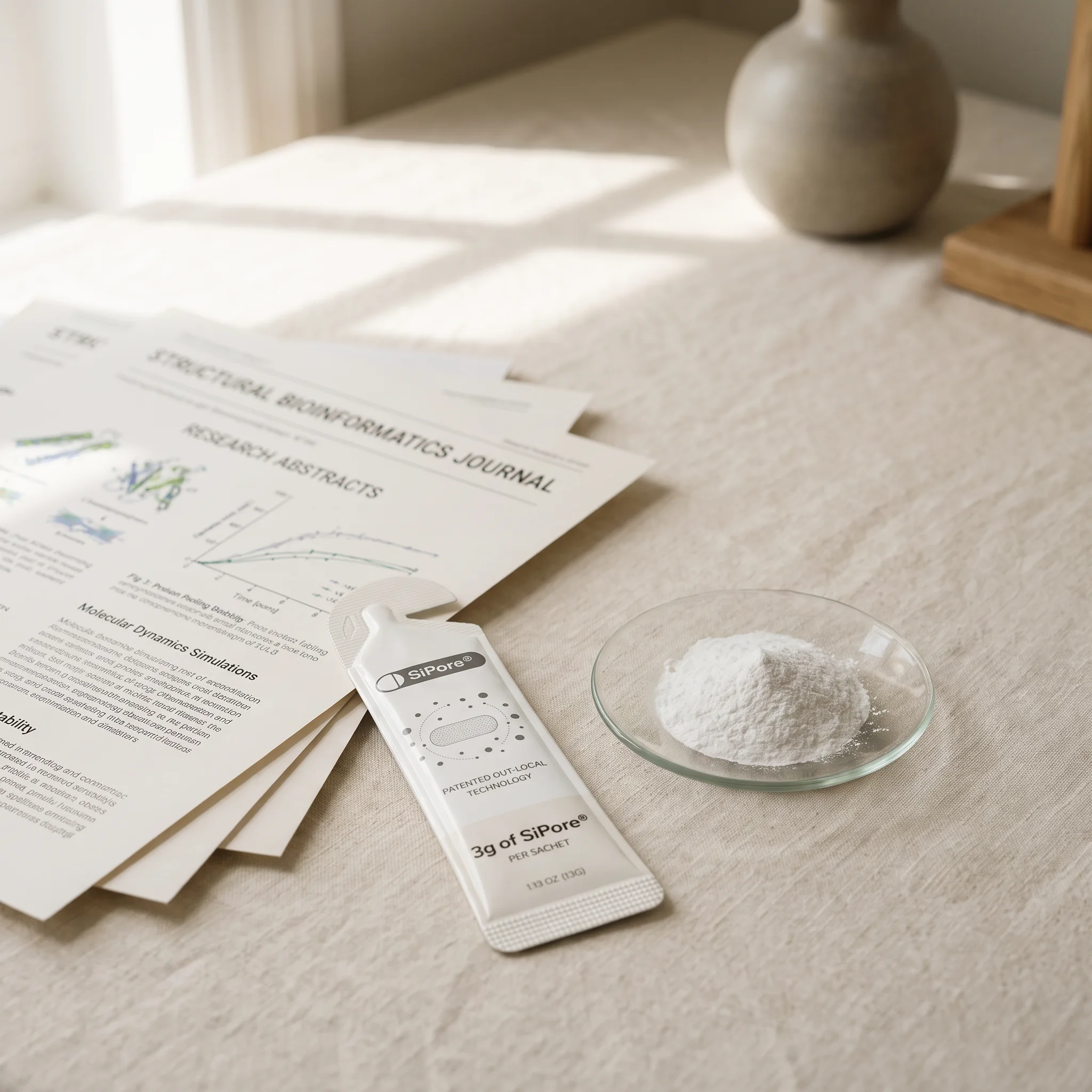
Journal pages and an engineered porous silica particle
FEATURED PUBLICATION · 2026 · HUMAN CLINICAL

The SHINE Trial

Baek J, et al.

Effect of engineered mesoporous silica particles with tailored pore size on glycaemic control in individuals with prediabetes or type 2 diabetes: a randomised, double-blind, placebo-controlled SHINE trial

eClinicalMedicine. 2026;97:104042.

Randomized, double-blind, placebo-controlled clinical trial · N=318

The publication reports the largest SiPore® clinical study conducted to date, evaluating engineered mesoporous silica in individuals with prediabetes or type 2 diabetes.

eClinicalMedicine972026Original at eClinicalMedicine ↗

The publication reports the largest SiPore® clinical study conducted to date, evaluating engineered mesoporous silica in individuals with prediabetes or type 2 diabetes.

PUBLICATION LIBRARY

All publications — newest first

YearPublicationResearch areaJournalDetails
2026 · HUMAN CLINICALClinical efficacy & safetyeClinicalMedicine
Details
Research question
Does engineered mesoporous silica with tailored pore size improve glycaemic control in individuals with prediabetes or type 2 diabetes compared with placebo?
Study type
HUMAN CLINICAL
Population / model
SHINE · Randomized, double-blind, placebo-controlled · N=318
Key takeaway
The largest SiPore® clinical study conducted to date, evaluating engineered mesoporous silica in individuals with prediabetes or type 2 diabetes.
Full citation
Baek J, et al. Effect of engineered mesoporous silica particles with tailored pore size on glycaemic control in individuals with prediabetes or type 2 diabetes: a randomised, double-blind, placebo-controlled SHINE t. eClinicalMedicine. 2026;97:104042.
External links
Read the paper /docs/shine-trial
2023 · MECHANISM / TRANSLATIONALGut-local behavior & particle integrityACS Applied Materials & Interfaces
Details
Research question
Do mesoporous silica particles keep their structure and function while passing through the gastrointestinal tracts of mice and humans?
Study type
MECHANISM / TRANSLATIONAL
Population / model
Gut-local behavior & particle integrity
Key takeaway
The research investigated how mesoporous silica particles behave while passing through the gastrointestinal tract and provides evidence relevant to their gut-local, non-systemic behavior.
Full citation
Iqbal et al. Mesoporous Silica Particles Retain Their Structure and Function while Passing through the Gastrointestinal Tracts of Mice and Humans. ACS Applied Materials & Interfaces.
External links
View publication doi.org/10.1021/acsami.2c16710
Related SiPore® content
Explore Safety & Tolerability
2023 · MECHANISM / PRECLINICALMode of action / enzyme entrapmentACS Materials Au
Details
Research question
How active and stable is the digestive enzyme alpha-amylase when it is confined within the pores of mesoporous silica?
Study type
MECHANISM / PRECLINICAL
Population / model
Mode of action / enzyme entrapment
Key takeaway
The study investigated alpha-amylase within mesoporous silica pores and supports the physical enzyme-entrapment mechanism.
Full citation
Iqbal et al. Activity and Stability of Nanoconfined Alpha-Amylase in Mesoporous Silica. ACS Materials Au.
External links
View publication doi.org/10.1021/acsmaterialsau.3c00028
Related SiPore® content
Explore Technology
2022 · HUMAN CLINICALHuman clinical / metabolic outcomesNanomedicine (Lond)
Details
Research question
What effect does engineered mesoporous silica have on long-term blood glucose, HbA1c and other metabolic parameters in individuals with prediabetes or newly diagnosed type 2 diabetes?
Study type
HUMAN CLINICAL
Population / model
STAR · Proof-of-concept clinical study · N=43
Key takeaway
The STAR publication reports human clinical research in individuals with prediabetes or newly diagnosed type 2 diabetes.
Full citation
Baek J, et al. Engineered mesoporous silica reduces long-term blood glucose, HbA1c, and improves metabolic parameters in prediabetics. Nanomedicine. 17(1):9-22.
External links
View publication doi.org/10.2217/nnm-2021-0235
Related SiPore® content
View study overview
2022 · PRECLINICALLipase & lipid digestionEur J Pharm Biopharm
Details
Research question
How does mesoporous silica affect lipase activity, lipid digestion and fat absorption as a possible approach to obesity treatment?
Study type
PRECLINICAL
Population / model
Lipase & lipid digestion
Key takeaway
Evidence from this preclinical research investigated lipase adsorption, lipid digestion and fat uptake in animal models.
Full citation
May KL, et al. Towards mesoporous silica as a pharmaceutical treatment for obesity - impact on lipid digestion and absorption. European Journal of Pharmaceutics and Biopharmaceutics. 173:1-11.
External links
View publication doi.org/10.1016/j.ejpb.2022.02.001
Related SiPore® content
View preclinical evidence
2020 · HUMAN CLINICAL / MECHANISMHuman clinical / mechanismAdvanced Healthcare Materials
Details
Research question
Can engineered mesoporous silica particles entrap digestive enzymes in humans, and how does this relate to metabolic risk factors?
Study type
HUMAN CLINICAL / MECHANISM
Population / model
First-in-Man research program · N=20
Key takeaway
This paper reports metabolic and mechanism findings from the First-in-Man research program, including investigation of digestive-enzyme entrapment.
Full citation
Waara ER, et al. Entrapping Digestive Enzymes with Engineered Mesoporous Silica Particles Reduces Metabolic Risk Factors in Humans. Advanced Healthcare Materials. 9(11):e2000057.
External links
View publication doi.org/10.1002/adhm.202000057
Related SiPore® content
Explore Technology
2020 · HUMAN SAFETYHuman safety & tolerabilityPLOS ONE
Details
Research question
Is oral intake of mesoporous silica safe and well tolerated in healthy men?
Study type
HUMAN SAFETY
Population / model
First-in-Man · Dedicated human safety and tolerability study · N=20
Key takeaway
An early human evaluation focused specifically on the safety and tolerability of oral mesoporous silica.
Full citation
Hagman E, et al. Oral intake of mesoporous silica is safe and well tolerated in male humans. PLOS ONE. 15(10).
External links
View publication doi.org/10.1371/journal.pone.0240030
Related SiPore® content
Explore Safety & Tolerability
2020 · PRECLINICALEngineered pores & animal metabolismNanomedicine (Lond)
Details
Research question
How does a precisely controlled pore structure in mesoporous silica influence food efficiency, weight gain and fat accumulation in mice?
Study type
PRECLINICAL
Population / model
Engineered pore structure & animal metabolism
Key takeaway
The animal research investigated how precisely controlled pore structure influenced nutrient utilization, body weight and fat accumulation.
Full citation
Rinde M, et al. Mesoporous silica with precisely controlled pores reduces food efficiency and suppresses weight gain in mice. Nanomedicine. 15(2):131-144.
External links
View publication doi.org/10.2217/nnm-2019-0262
Related SiPore® content
View preclinical evidence
2014 · PRECLINICALEarly preclinical metabolic researchNanomedicine (Lond)
Details
Research question
What are the metabolic effects of large-pore mesoporous silica in obese mice?
Study type
PRECLINICAL
Population / model
Early preclinical metabolic research
Key takeaway
An early SiPore®-related animal study investigating the metabolic effects of large-pore mesoporous silica.
Full citation
Kupferschmidt N, et al. Large pore mesoporous silica induced weight loss in obese mice. Nanomedicine (London). 9(9):1353-1362.
External links
View publication doi.org/10.2217/nnm.13.138
Related SiPore® content
View preclinical evidence
HUMAN CLINICAL PUBLICATIONS

Four peer-reviewed papers.

There are four peer-reviewed human clinical papers in the current publication set. Two papers originate from the same First-in-Man study, so the number of publications should not be confused with the number of separate clinical trials.

YearPublicationResearch areaJournalDetails
2026 · HUMAN CLINICALClinical efficacy & safetyeClinicalMedicine
Details
Research question
Does engineered mesoporous silica with tailored pore size improve glycaemic control in individuals with prediabetes or type 2 diabetes compared with placebo?
Study type
HUMAN CLINICAL
Population / model
SHINE · Randomized, double-blind, placebo-controlled · N=318
Key takeaway
The largest SiPore® clinical study conducted to date, evaluating engineered mesoporous silica in individuals with prediabetes or type 2 diabetes.
Full citation
Baek J, et al. Effect of engineered mesoporous silica particles with tailored pore size on glycaemic control in individuals with prediabetes or type 2 diabetes: a randomised, double-blind, placebo-controlled SHINE t. eClinicalMedicine. 2026;97:104042.
External links
Read the paper /docs/shine-trial
2022 · HUMAN CLINICALHuman clinical / metabolic outcomesNanomedicine (Lond)
Details
Research question
What effect does engineered mesoporous silica have on long-term blood glucose, HbA1c and other metabolic parameters in individuals with prediabetes or newly diagnosed type 2 diabetes?
Study type
HUMAN CLINICAL
Population / model
STAR · Proof-of-concept clinical study · N=43
Key takeaway
The STAR publication reports human clinical research in individuals with prediabetes or newly diagnosed type 2 diabetes.
Full citation
Baek J, et al. Engineered mesoporous silica reduces long-term blood glucose, HbA1c, and improves metabolic parameters in prediabetics. Nanomedicine. 17(1):9-22.
External links
View publication doi.org/10.2217/nnm-2021-0235
Related SiPore® content
View study overview
2020 · HUMAN CLINICAL / MECHANISMHuman clinical / mechanismAdvanced Healthcare Materials
Details
Research question
Can engineered mesoporous silica particles entrap digestive enzymes in humans, and how does this relate to metabolic risk factors?
Study type
HUMAN CLINICAL / MECHANISM
Population / model
First-in-Man research program · N=20
Key takeaway
This paper reports metabolic and mechanism findings from the First-in-Man research program, including investigation of digestive-enzyme entrapment.
Full citation
Waara ER, et al. Entrapping Digestive Enzymes with Engineered Mesoporous Silica Particles Reduces Metabolic Risk Factors in Humans. Advanced Healthcare Materials. 9(11):e2000057.
External links
View publication doi.org/10.1002/adhm.202000057
Related SiPore® content
Explore Technology
2020 · HUMAN SAFETYHuman safety & tolerabilityPLOS ONE
Details
Research question
Is oral intake of mesoporous silica safe and well tolerated in healthy men?
Study type
HUMAN SAFETY
Population / model
First-in-Man · Dedicated human safety and tolerability study · N=20
Key takeaway
An early human evaluation focused specifically on the safety and tolerability of oral mesoporous silica.
Full citation
Hagman E, et al. Oral intake of mesoporous silica is safe and well tolerated in male humans. PLOS ONE. 15(10).
External links
View publication doi.org/10.1371/journal.pone.0240030
Related SiPore® content
Explore Safety & Tolerability
MECHANISM & PRECLINICAL PUBLICATIONS

Five peer-reviewed papers spanning 2014-2023.

The published preclinical and mechanism literature covers gut-local particle behavior, enzyme entrapment, lipid digestion and animal metabolic research.

YearPublicationResearch areaJournalDetails
2023 · MECHANISM / TRANSLATIONALGut-local behavior & particle integrityACS Applied Materials & Interfaces
Details
Research question
Do mesoporous silica particles keep their structure and function while passing through the gastrointestinal tracts of mice and humans?
Study type
MECHANISM / TRANSLATIONAL
Population / model
Gut-local behavior & particle integrity
Key takeaway
The research investigated how mesoporous silica particles behave while passing through the gastrointestinal tract and provides evidence relevant to their gut-local, non-systemic behavior.
Full citation
Iqbal et al. Mesoporous Silica Particles Retain Their Structure and Function while Passing through the Gastrointestinal Tracts of Mice and Humans. ACS Applied Materials & Interfaces.
External links
View publication doi.org/10.1021/acsami.2c16710
Related SiPore® content
Explore Safety & Tolerability
2023 · MECHANISM / PRECLINICALMode of action / enzyme entrapmentACS Materials Au
Details
Research question
How active and stable is the digestive enzyme alpha-amylase when it is confined within the pores of mesoporous silica?
Study type
MECHANISM / PRECLINICAL
Population / model
Mode of action / enzyme entrapment
Key takeaway
The study investigated alpha-amylase within mesoporous silica pores and supports the physical enzyme-entrapment mechanism.
Full citation
Iqbal et al. Activity and Stability of Nanoconfined Alpha-Amylase in Mesoporous Silica. ACS Materials Au.
External links
View publication doi.org/10.1021/acsmaterialsau.3c00028
Related SiPore® content
Explore Technology
2022 · PRECLINICALLipase & lipid digestionEur J Pharm Biopharm
Details
Research question
How does mesoporous silica affect lipase activity, lipid digestion and fat absorption as a possible approach to obesity treatment?
Study type
PRECLINICAL
Population / model
Lipase & lipid digestion
Key takeaway
Evidence from this preclinical research investigated lipase adsorption, lipid digestion and fat uptake in animal models.
Full citation
May KL, et al. Towards mesoporous silica as a pharmaceutical treatment for obesity - impact on lipid digestion and absorption. European Journal of Pharmaceutics and Biopharmaceutics. 173:1-11.
External links
View publication doi.org/10.1016/j.ejpb.2022.02.001
Related SiPore® content
View preclinical evidence
2020 · PRECLINICALEngineered pores & animal metabolismNanomedicine (Lond)
Details
Research question
How does a precisely controlled pore structure in mesoporous silica influence food efficiency, weight gain and fat accumulation in mice?
Study type
PRECLINICAL
Population / model
Engineered pore structure & animal metabolism
Key takeaway
The animal research investigated how precisely controlled pore structure influenced nutrient utilization, body weight and fat accumulation.
Full citation
Rinde M, et al. Mesoporous silica with precisely controlled pores reduces food efficiency and suppresses weight gain in mice. Nanomedicine. 15(2):131-144.
External links
View publication doi.org/10.2217/nnm-2019-0262
Related SiPore® content
View preclinical evidence
2014 · PRECLINICALEarly preclinical metabolic researchNanomedicine (Lond)
Details
Research question
What are the metabolic effects of large-pore mesoporous silica in obese mice?
Study type
PRECLINICAL
Population / model
Early preclinical metabolic research
Key takeaway
An early SiPore®-related animal study investigating the metabolic effects of large-pore mesoporous silica.
Full citation
Kupferschmidt N, et al. Large pore mesoporous silica induced weight loss in obese mice. Nanomedicine (London). 9(9):1353-1362.
External links
View publication doi.org/10.2217/nnm.13.138
Related SiPore® content
View preclinical evidence
PUBLICATIONS & THE RESEARCH PROGRAM

Not every study is a publication.

Not every study in the SiPore® research program has been published in a peer-reviewed journal.

SiPore®’s research program includes both peer-reviewed published research and additional controlled studies documented through internal clinical study reports. This Publications library includes peer-reviewed scientific papers only. For the broader evidence program - including clinical studies that have not yet been published in a journal - visit Research & Evidence.

9 publications across more than a decade of research.

9 PEER-REVIEWED PUBLICATIONS

The peer-reviewed SiPore® literature spans:

Human clinical evaluation Safety & tolerability Digestive-enzyme mechanism Gut-local particle behavior Carbohydrate and lipid digestion Preclinical metabolic research